Demo 2017 is a uptempo danceable punk splurge of weirdo rock’n’roll archived in stripped-dry production. Its wirey and agile songwriting keeps things moving and interesting for the whole 14 minute ride. What more could you want from a demo?
KAPUTT’s guitar work is, in some way, in lineage of Devo’s Bob 1 and Jerry Casale, while drummer Rikki Will and saxophonist Chrissy Barnacle take a laid back but nevertheless meticulous playing style reminiscent of The Cardiac’s Dominic Luckman and Sarah Smith, respectively.
The band has since released the full-length album Carnage Hall (a demo of the title track appears here on Demo 2017) as well as 2 singles. You can go check out Carnage Hall now, or keep a look out on Resident Sound, as I’m sure I’ll be revisiting KAPUTT more in the coming weeks.
For fans of: The Cardiacs, James Chance & The Contortions, Devo
If the members of either Frankie Cosmos (US) or Hazy Sour Cherry (Japan) ever see this, for the love of god, go on tour together. Your audiences may just see the best show of their lives.
Hazy Sour Cherry wastes no time getting into its melancholic, somewhat beach-y style of indie rock. Drums, guitar, bass and vocals hit the listener with immediate clarity on opening track I Need Your Heart, putting the band’s song-writing skills front and center. But don’t be confused by Tour De Tokyo’s clarity and delicate guitar work, this record is raw. Occasional chimes and vocal backing only enhance the already well written songs’ emotional communication atop its very warm instrumentals.
The emotions are forefront, and it’s perfectly-raw engineering opens the runway to any potential listener, even those whose listening habits may be a little intense.
Tour De Tokyo is, in a lot of ways, the perfect album. The use of light melancholy works as a cohesive bond between each songs’ varying intensities and slight stylistic changes. So what am I saying? Well, Hazy Sour Cherry manages to break free of the monotonous uniformity that befall most indie, punk, and rock acts, which is incredibly refreshing and hopeful.
I regularly listen to this record from start to finish, and I recommend you give it a try.
Suffocating the listener in a liminal world drenched in fog, the dampened sound of a pumpjack groans on under a layer of reverb. Rarely about what is, almost entirely about what isn’t, the doom jazz genre has been the go-to for our inner Agent Dale Coopers since Twin Peaks first went off the air in the summer of 1991. Without further ado, here is Resident Sound’s Guide to Doom Jazz…
In many ways, it is anything but jazz. Post-rock at its lightest, doom jazz is a post-metal, dark ambient blend of avant-garde and film-score influences, with jazz aesthetics and associated instruments. Brushed drums and stand-up bass drag us slowly into a shadow in which the only recognizable feature may be the occasional saxophone drudgery. The rare vocal not sung in giallo horror tongues speak is a rare find. So where do we get started?
Bohren & der Club of Gore
An early influence and common theme within doom jazz is composer Angelo Badalamenti’s score for David Lynch’s cult-classic turned pop culture phenomenon Twin Peaks. Debuting in August of 1990, Twin Peaks had only gone off the air the previous year when Bohren & der Club of Gore was founded in Mülheim an der Ruhr, Germany in 1992. For a long time its members, former hardcore punk musicians, were seemingly the only individuals of this dark ethereal genre-to-be. There was no fashion, no statement pieces, no major-label deals or infamous underground record collecting stories. In a decade defined by x-treme cool ranch and Limp Bizkit, doom jazz’s shadowy grip on dark music would grow slowly over the coming decades.
Advertisements
The Kilimanjaro Darkjazz Ensemble
TKDE, initially a duo, formed in Utrecht, Netherlands in 2000 as a project for scoring silent films. By 2007, the ensemble had grown to seven members with instrumentation consisting of cello, violin, guitar, trombone, and more. Unlike their peers, The Kilimanjaro Darkjazz Ensemble would have a sparse discography, culminating in the 2011 crowd-funded From The Stairwell LP and a live album that same year before quietly disbanding in 2014.
Denovali Records
Being the fractured scene that it is, it can seem as if these groups are destined to return to the shadows from which they once came.
Since the dissolution of The Kilimanjaro Darkjazz Ensemble there’s been no word of them returning, but in 2016, Denovali Records (the closest thing to a scene anchoring point) began to release the TKDE discography on their digital label, allowing for greater accessibility through Bandcamp.
Denovali Records may be the closest we see to a subcultural anchor anytime soon. Started in 2005, the independent label has seen itself curate and release a roster as sonically diverse as ambient, electronica, drone, jazz, and sound art. Thanks to them, doom jazz has become accessible to those who wish to get involved. Denovali is now home to The Kilimanjaro Darkjazz Ensemble, The Mount Fuji Doomjazz Corporation, and one of my favorite groups; The Dale Cooper Quartet.
Advertisements
Dale Cooper Quartet
Formed in 2002 at a jazz improvisation night, The Dale Cooper Quartet (occasionally styled as DC4tet) came together over a love of Angelo Badalamenti and doom jazz predecessors Bohren & der Club of Gore. Their first and perhaps most recognizable release came in 2006 with Parole de Navarre on French electronic label Diesel Combustible. DC4tet’s explicit Twin Peaks reference and the accessibility afforded to ambient music and Twin Peaks fans alike in the second half of the naughts helped put them at the forefront of what is now a somewhat-google-able genre.
You can read an interview with DC4tet at Welcome to Twin Peaks, a Twin Peaks fan site.
The Mount Fuji Doomjazz Corporation
Described by Denovali Records as the “much-noticed free-form, drone metal / jazz alter-ego of The Kilimanjaro Darkjazz Ensemble,” The Mount Fuji Doomjazz Corporation is the improvisational spin-off of TKDE. Started in 2007 only as a live project, their early performances were recorded and eventually released as Doomjazz Future Corpses! in 2007 on the Ad Noiseam record label. This was followed up in 2009 by Succubus, arguably the most visually recognizable album in the genre, then three more albums. Mount Fuji disbanded in 2012 having put out more work than the original Kilimanjaro ensemble.
Advertisements
Is that all there is…?
Maybe doom jazz has reached a logical conclusion. An early pioneer of the metamodernist practice of oscillation between modernist and postmodernist ideology; doom jazz oscillates between many of theorist Jonathan Kramer’s proposed characteristics of postmodernist music and the modernist techniques and styles proposed by musicologist Daniel Albright, such as expressionism, abstractionism, and hyperrealism. As more metamodernist approaches to music are explored, doom jazz has a chance to be reignited by newer groups, but perhaps it will be left alone as new styles emerge from the same school of thought.
In a time when nearly all artistic ideas can be easily shared, the legitimacy of an idea isn’t held hostage to any regional scene’s ability to create the cultural cohesion previously necessary (think of the social climates that lead to the formation of punk, grunge, or even free jazz) to catapult a band into any degree of national attention or audience. Neither immediately positive or negative, the loss of this necessity mixed with the hyper commercialization of all niches has lead us to a post-subcultural way of living. In a world increasingly focused on quantitative consumption of content oriented media and a lowered barrier of entry (lower stigmatization, higher accessibility), it could be said we live in a niche-aesthetics cultural society, no longer held together by community ties.
So in keeping with its metamodernist leanings, where does doom jazz go from here? For a genre whose first wave rose and crashed as slow as its tempo, what will it take for second wave to distinguish itself? It may be another 20 years before we see it in full swing. But now as we speak, the 2030s/40s are already doomed.
Acetantina, now working as Kaiso Slumber, is the name of a Libyan-German electronic producer working out of Khartoum, Sudan (according to their Bandcamp bio).
Temple of Null full-heartedly embraces the visual and sonic aesthetics of vaporwave while working at a much more frenetic tempo and energy than their vaporwave counterparts. At 35 minutes, this 11-track album is about as professional and polished sounding you’ll ever hear in vaporwave music. Well mixed, well mastered, while managing to keep volume dynamics present in each individual song. While I’m always tempted to put on opening track Puddle of Nitrogen on repeat, Temple of Null works incredibly well as one coherent piece. Tracks like Puddle of Nitrogen, Lonely Network, and Foot Cramp propel the listener forward, throwing the listener into a digital wind tunnel of rolling hi-hats, atmospheric pads and strange digital blips and glitches. The melancholy prevalent in most vaporwave releases is front and center, but Acetantina knows when and where to pull away (Foot Cramp) and when to double down (Lonely Network). If you were to own any vaporwave-adjacent album, make it Temple of Null by Acetantina.
Released in 2001 on Ant.Zen Records out of Lappersdorf, Germany, The Secret is a 5 song EP by Australian singer Veruschka and producer David Thrussell (Snog, Soma, Black Lung).
The Secret thrives in its cinematic-centricity, degrees of warmth are faintly revealed with vinyl fuzz layers and occasional hand percussion. Slow swelling orchestral synths loom heavily behind the otherwise minimal instrumentation, topped with Veruschka’s neoclassical darkwave vocal styling. Where The Secret falters is in the end with vocal-forward tracks Boredom Kills and The Fruits. This isn’t to say Veruschka’s singing is bad, simply that the vocals aren’t utilized in a way that ultimately enhances the cinematic element as much as they could, which leaves the set-up of opening tracks The Secret and The Department unfulfilled.
What could be accountable for this a lack of post-production focus on vocal tracks, or simply a disconnect from producer to performer. Sure, this thinking may reek of cliche label-control, but what I propose is that when the artist is the producer, the producer needs to play a stronger roll in direction if the artistic vision can’t be reached in the already highly-synthetic post-production process that we hear in trip-hop, sampledelia, and other musique concrète adjacent genres.
Alternatively, it can be hard to say what the business arrangement was for this album and how that effected it. Maybe producer David Thrussell played a secondary roll, maybe there were financial or time restraints with having the album produced. Unfortunately we haven’t seen a second release from this duo, which could very well right the course with a stronger follow-up.
While The Secret may lack the vocal prowess of Portishead’s Beth Gibbons, the cold, cinematic production and ethereal Dead Can Dance-esque vocals should win over most fans of Portishead’s Dummy or Tricky’s Maxinquaye.
Whether chasing ghosts or appreciating novelty, the ‘lost to time’ element of dollar-bin records can leave their songs steeped in melancholy. As vinyl continues to wade further back into the mainstream, the previously murky world of thrift vinyl collecting has been cast into the light of social media; documented and showcased for any passers by.
I recently fell in love with the Instagram account Lost RPM during the pandemic’s ever growing hours at home. Lost RPM is DJ and curator Jeffrey Harvey’s showcase of notable finds, most only known to the artists themselves and few seasoned vets of the thrift record collecting world.
To get a better idea of what drives the record thrifting mindset, I reached out to Jeffrey Harvey of The Lost RPM Podcast and Instagram account to explore their place in the record collecting scene. The following interview took place over the course of about a week via email.
Jeffrey of Lost RPM:
Hey [Lubert]! It’s Jeffrey. Good to meet you. Fire away on Q’s and I’ll try to answer as best I can!
Lubert:
Hey Jeffrey! Good to meet you too. Let’s get started.
You run the Instagram account Lost RPM and the coinciding Lost RPM Podcast. I see that the earliest Instagram posts at this time go back to 2015, though the focus wasn’t always on 45s, but mostly LPs. Incredible but strange records like Sister Janet Mead’s ‘The Lord’s Prayer’ and Robert Pritikin’s ‘There’s A Song in My Saw’. What led to the switch to covering 45s more or less exclusively?
Jeffrey:
That’s a great question! I moved from Kansas City, Missouri to Los Angeles in 2013 to get married. I had been collecting interesting-to-me records in KC since the early 2000s, with most of my collection coming from thrift stores, junk shops, flea markets, and record store clearance bins. I was very passionate (and still am) about finding cool records that someone else has literally thrown out!
Anyway, when I arrived in LA I didn’t have any professional plans or goals per se, so that led to copious amounts of time continuing my second-hand record search. I was able to get to know the city by starting the day at a Pasadena Salvation Army and ending the day at a Van Nuys Goodwill. Along the way I’d look for LPs/45s/78s that looked interesting, were privately pressed, or unknown to me at the time.
In Kansas City 45s are everywhere. You go into any thrift store and there are at least a few stacks of 45s – even if they’re all crap. In LA I found that 45s at thrift stores are virtually non-existent. That led me to finding a lot of stuff like the Sister Janet Mead and Robert Pritikin LPs. I’d find a handful of $1 private press LPs during a day out digging, get ’em home, and spend the evening trying to figure out if they were any good or not. It helped that recreational cannabis was just starting to become legal in Southern California lol. After a year or so of SoCal second-hand record digging, I started kicking around the idea of starting a blog about my finds. That’s how The Lost RPM Instagram page came about.
Interestingly enough, my run of posting primarily 45s didn’t start until the pandemic kicked into high gear in March of 2020. I ordered a 45 on Discogs from a seller who had like 16,000+ records for sale, and casually mentioned that if he had any “not on Discogs or ungoogleable records” lying around that he wanted to get rid of, I’d buy them off him in bulk. To my surprise he said he did, and that he’d be down to sell to me. So for the past year I’ve been receiving boxes of 100 45s once or twice a month. I can’t tell you how much it helped me mentally during the pandemic, and receiving all those singles actually kickstarted the idea of The Lost RPM Podcast. That’s the entire reason my IG page has transitioned to mostly all 45s.
Lubert:
16,000 records is a LOT of records. I can’t imagine some of the strange stuff that seller has. 45 collecting alone has its niches from Georgia gospel to absurd novelty, Philly soul to stabs at country stardom. You seem to span the gamut. Are there any particular niches you swoon over? Any genres you’re looking to explore further?
Jeffrey:
It’s interesting, when I was in high school I was pretty chubby. I tried to cover up my self-consciousness about my weight with being the class clown. Being the class clown led me to becoming friends with all types of people in my school. Punk rockers, jocks, cheerleaders, art kids, outsiders, and even teachers. I didn’t really have a specific friend group or click that I was a part of, and as crazy as it sounds I honestly feel like that experience somehow translated into my record collecting. I don’t really seek out one specific genre, I just like what connects with me. I actually believe that in most cases records are meant to find me, rather than the other way around.
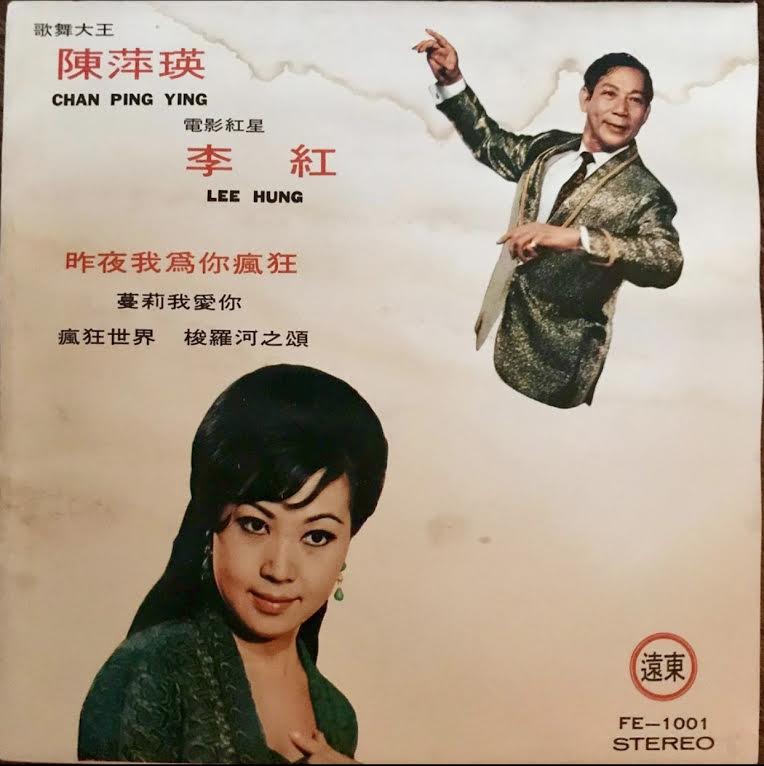
Case in point: I was at a Salvation Army in the LA area a few years back. I had just found a handful of really cool LPs, and as I was exiting the store on a digging-score high, I saw two Asian gentlemen loading up a cart with records to donate. I walked up to them, told them I collect, and asked if they wanted to sell to me instead. I think I paid $15 for a few boxes of LPs, 78s, and 45s. I had no idea what was in the boxes. I didn’t even care. I just knew if something needed to find me, it would. Most of the stuff ended up being useless to me (and was even donated back to the Salvation Army from whence it came lol), but one of the few items I kept from that haul ended up being this amazing, unknown, and seemingly one-of-a-kind 1960s Hong Kong pop 7″ EP that may or may not be from a feature film. I can’t find any info on it. All I know is that there’s a track on the disc that absolutely floors me. It sounds like it was recorded in an opium den, and I’ve never heard anything like it since. What are the odds of all the factors coming together in that scenario for that record to find me? I have to think they’re pretty astronomical. I cherish that 7″ EP and the fact that it found me! I’ve attached a pic of the release and mp3 of the track if you want to check it out.
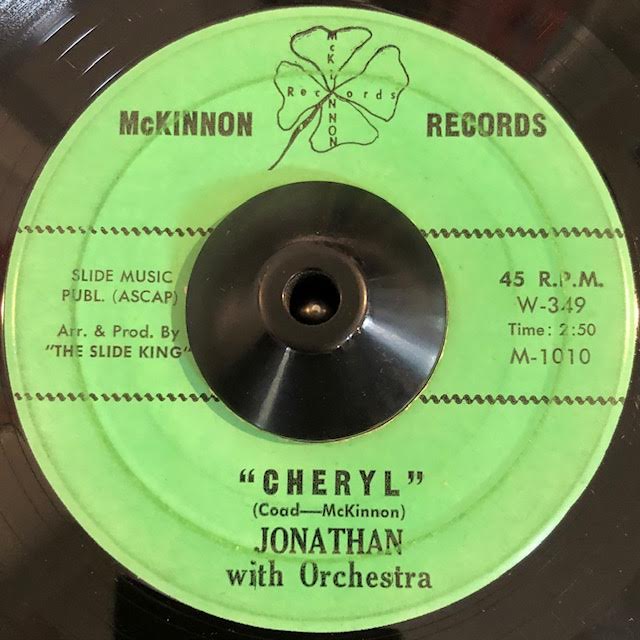
As far as stuff I swoon over, that would definitely be 1950s/60s American outsider teenage ballads. It’s total time capsule stuff. I have a 45 by a group called “Jonathan with Orchestra” that is a perfect example of waaaaaay outsider teenage balladry. It’s called “Cheryl” and it’s one of the most amazing & endearing things I’ve ever heard. The kid (presumably Jonathan) can’t even sing. His voice cracks heavily throughout the recording, and there’s even some amateur saxophone playing involved. It’s all so innocent and primitively debauched at the same time. It’s like something you’d hear at a high school prom in 1957, if the prom was held at an insane asylum. I’ve actually found a fair share of primitive, obscure, outsider teenage singles from the 50s & 60s, and am always down to welcome more of them into my life. Again, I’ll attach a pic of the label and mp3 of that one for your consideration.
Lubert:
I just listened to both of these records and they’re great in their own ways. The Hong Kong record reminds me a bit of the bossa nova influence on easy-listening pop records. Really high quality writing and production. But this Jonathan record, well it sounds like James Hurley in Twin Peaks!
Total time capsule stuff, for real. So, is Jonathan With Orchestra what you’d call a “real people” record? It’s a term you’ve used before in the Lost RPM Podcast liner notes, but it’s also a term heard throughout music collecting circles. What is implied by this, and how do they differ from other records of their era?
Jeffrey:
You have a good ear! I didn’t include this above, but the Hong Kong track actually seems to be a take on the Afro-Cuban song “Tabú” or “Taboo” that Arthur Lyman made famous with his easy listening exotica of the late 50s/early 60s. Google it and you’ll hear the same exact melody!
Yes, the Jonathan with Orchestra single would be a prime example of a “real people record.” The term comes from legendary private press record collector Paul Major, who has found more amazing records than I could ever dream of. He stated in a interview with Vice Magazine in 2017 that “Real People popped into my head as a catch-all phrase to cover vastly different styles of music resulting from driven persons creating highly personal sounds that were able to capture their uniqueness as human beings… Their true personalities are captured, I feel like I am inside their brains when I hear them. It is an elastic term but the key thing about Real People is that the person is impossible to separate from the art.”
That last part kills me, and is so eloquently said! The person being impossible to separate from the art really is the essence of real people or outsider music. The overt self expression, highly personal nature, and unintentional urgent spirit of the recordings are what give them their charm. This, in my opinion, is what separates the real people records of various decades from other records of their era. Also to Paul’s point, you almost always feel like you’re “inside the brain” of the “artist” when listening to a real people record. I know I feel that way when listening to the Jonathan record 🙂
Also, I use quotations on the term artist there because many of the people who recorded this stuff probably didn’t even see themselves as artists at the time!
Lubert:
It may be safe (or arrogant) to say that a lot of these artists had hopes or intentions of reaching some kind of audience or commercial success, either by luck or imitating commercially successful performers. At what point does a record leave ‘the arts’ and enter a more entertainment/media content standing? Does commercialism take away from the sort of human or ‘genuine’ artistic element in a work?
Jeffrey:
I think it’s safe to say the majority of these artists had some sort of hopes or aspirations of stardom. It’s also probably safe to say there were a large contingent of record industry hucksters promising these artists the world and not delivering. Have you heard of, or researched the tax scam record labels of the 1970s & 80s? That’s a whole other topic in itself!
As far as commercialism taking away from the genuine or human artistic element in a recorded work, I don’t really subscribe to that idea. I love Donovan. Like really love him. His laid-back brand of psychedelic hippie-folk is about as commercial as it gets for the 1960s. I also feel like he’s super genuine sounding, and about as human as it gets. I challenge anyone to listen to “Sand and Foam” from the Sunshine Superman album and not be moved. But then again music – as with most art – is totally subjective.
Lubert:
I do love me some Donovan records. The push and pull of commercialism and its effect on art is a dichotomy that’s seemingly in a constant state of implosion, so any attempt to draw a line in the sand may be in vain. But tax scam record labels? I need to look into that! I know there was some mafia involvement with smaller soul labels in the North East around that time, but this is news to me. Speaking of labels, The Lost RPM Podcast really opens up your collection to the world by streaming some select cuts. Are you ever concerned about copyright hawks? Or does a lot of the music fall into the public domain by way of abandonment?
Jeffrey:
Yeah when it comes to tax scam records the Stonewall self-titled LP on Tiger Lily is a nice one to start with. My buddy Lance from Permanent Records here in LA was the first to do an officially licensed reissue with the surviving members of the band. It’s pretty killer!
As far as copyright concerns go, I would say that I’m a pretty under-the-radar operation at this point who caters to a very niche market. I just love sharing lost and overlooked music with people. Now if this interview were to run in like Vanity Fair or something then I might have some second thoughts about copyright stuff lol, but man most of the records I dig on are pretty obscure. That, coupled with the fact that I don’t make any money off The Lost RPM doesn’t really have me concerned. If someone wants me to take something down or cease and desist with something, I have no problem doing that.
Lubert:
There are some labels out there that work at restoring and sharing old records from the 1910s and later on, as well as other ‘lost to time’ records from the later 1900s that have gained new audiences they otherwise wouldn’t have ever had. Would you ever consider starting up your own label, be it physical releases, or free digital downloads and re-releasing or creating compilations of some of these really obscure records? Or is that something you’d like to stay out of?
Jeffrey:
You’re not doing a good job at alleviating my fear that this will run in Vanity Fair hahaha.
Just kidding, but yeah I’ve had people tell me I should start a small label or release a comp, and I’m totally into the latter idea! I don’t think I have the time or energy to undertake a reissue label project, but I’d love to curate a 12 song compilation LP or something similar. That would be fun.
Lubert:
My blog posting is more of a ‘vanity affair’. Okay okay! Last question before I wrap things up. You collect all types of records with storied pasts. Usually we focus on the stories behind the record coming to be, but never the stories of the specific copies themselves. As a fan I have to ask; The Richard Ramirez 45. I gotta know what happened there.
Jeffrey:
Well I appreciate that you are a fan, and I appreciate you taking the time to reach out to me to talk outsider records. You’ve asked some very thought provoking questions, and I’ve really enjoyed our back-and-forth.
I’m sorry to have to break it to you though that the story behind the “Richard Ramirez” 45 is not really that interesting. I drove to Corona, CA the other week to pick up a box of 45s. The guy who sold them to me said they “belonged to his uncle.” I came home, sorted them out, and noticed the name Richard Ramirez written on a “Dick Clark All-Time Hits” EP. My wife and I had just watched the Night Stalker doc on Netflix, and I thought it was weird. I took a pic and posted it to the ‘gram. That’s it. That’s the story. Do you think it could have been him?
Lubert:
Oof! It may be a stretch, but it’s a spooky thought. It would definitely take a better sleuth than I to figure that out.
Alright, then. Thank you so much for your time! Run what you brung! Let folks know where they can find you!
This post originally appeared on the 10th Dentist blog on Friday, February 5th, 2021.
Japan has been the new frontier for Western metal audiences looking for something fresh.
Self Deconstruction’s chaotic punk microclipses and occasional 3/4 timing may bring a hint of familiarity for Rudimentary Peni fans, but its ultimate grindcore sensibilities make this a strong contender for any metal fan’s music collection.
Virtue presents a fully formed idea without succumbing to overindulgence. Each motif is given an equal sliver of time to present itself and exit stage left. This not even 5-minute album of near pure-aggression presents itself like a frenzied attack from a monster coming out of the bushes, rather than the hellscaped demonic journey common among American and European bands.
A distinction should be made to separate the term ‘raw’ from the often synonymously used (but quite different) ‘shitty’ sound worshiped among metal heads, edge lords, and the uninformed alike. No, this album is raw, and it serves its frenzied nature well. Well mixed, well recorded, Virtue’s fanciest production trick is its use of occasionally panned vocals. This album brings back memories of seeing south-eastern weirdo power-violence and grindcore bands in North Carolina, or of hearing Minor Threat 7”s, early Pig Destroyer, or Bad Brain’s Black Dot album for the first time.
For fans of: Pig Destroyer, Rudimentary Peni, Sete Star Sept
This post originally appeared on the 10th Dentist blog on Monday, January 25th, 2021.
2020 was not the best year for tours, though it seems Japanese punk rockers M.A.Z.E. were able to make it under the wire, finishing the final American leg of their tour in early March. This 6 track EP is a muddied lo-fi romp of wobbly processed guitars that only features 1 d-beat (on ‘Typical Credit’). Raw and seemingly untouched in post, Tour Tape 2020 may appeal to certain garage-rock circles but never bows to Thee Oh Sees-level dry-as-dust monotony.
What leads to some internal conflict for this listener is the band’s ‘punk’ self-identity. They are far too interesting to be lumped in with current western ‘punk,’ a vapid term for commercialized, dummy-jock rock. Though in Japan it seems as if ‘punk’ is being explored and experienced, not worn and modeled. Which is the real ‘punk’? Is the true ‘punk’ the easily digestible, take-no-risks rock? Or the off-beat, entry-level-0 art form? Simply, it doesn’t matter. The grey swath of ‘punk rock’ sycophants and fetishists will continue to worship and make legend of a scene many people (including my parents) just lived.
Who should be rewarded are the simon-pure with vision built through craft. While the willing mousinauts may find new favorites in Japanese and other non-anglophonic punk scenes, Cro-Mags fans may have difficulty sitting through closing track ‘Pink Wall.’
This post originally appeared on the 10th Dentist blog on Friday, March 5th, 2021.
Back in pre-covid days, as I faintly recall, Shorty Can’t Eat Books was introduced to me through a local barista (and I believe former member of the band) one morning before work. There is not much to be found on Shorty Can’t Eat Books. An Asheville, NC band whose only release was this 2014 self-titled album recorded at Hi Z / Lo Z Studio (now defunct) located in the back of Static Age Records. A music video for instrumental ruckus-romp surf punk song Breakdown was made and posted on Youtube to little fanfare a week before the album’s release. A sense of camaraderie may or may not have been shared over the laborious process of stop-motion animating. Such interactions are seen through rose-colored glasses now.
Tracks like I Was That Guy and Baby Baby are perfect examples of a specific vein of punk music that thrives within southern DIY circuits. Too honest for for indie hipsters and too weird for punks nationwide (with exception to the Midwestern scene, godbless’em). Essentially, the musical equivalent to The Captain & Casey Show.
After three tracks of fake-jazz verses and patio lounging surf diddies, it could be best described as the meeting of The Minutemen and Southern Culture on The Skids. That is of course until the aggression and secret agent-pastiche of Breakdown and Dumb Town break up the albums seemingly established route. Breakdown may be the longest (2 mins, 20 secds) the album goes with out sleazy ska horns, clunky no wave piano smashing, or (quite honestly) goofy (but fitting) bongo percussion parts.
Shorty Can’t Eat Books may be the quintessential Asheville band. They released one self titled album that fell on deaf ears, remembered only by long-time locals and dedicated scene goers. Their influences range incredibly and pastiche may be one of the three main ingredients. But through this is a great sense of honesty. This album is almost unforgivably North Carolinian. Lazy days on the patio, weird folk influences, and a lack of direct aggression that shows itself instead through scorned (but never embittered) melancholy.
As Asheville city officials and the tourism industry continues to kill and run out its locals through neglect (“sacrifice zone”), lobbyist interference, and lack of accountability, it’s important that outsiders remember what actually makes Asheville special; the locals. The locals who have created a sense of community, who have created the art, albums, and cool spaces you inevitably run them out of.
This angst over the city was certainly felt by many around this time, and maybe now more than ever after the empty promises of reparations to Asheville’s black community and the lack of support for local businesses. All of this makes closing track Nuclear Doowop’s melancholic desperation feel more like an omen and less a feeling of its time.
This post originally appeared on the 10th Dentist blog on Sunday, January 24th, 2021.
Released through Australian “Post-internet” label Sunset Grid on January 24th of 2021, MegaZoneEx’s SEAPUNK’D serves as a hopeful refresher of the vaporwave genre. While weaving their way through vaporwave and sister genres, MegaZoneEx explores but never falls victim to the cliches of those genres. Track highlights include the more accessible Ladytron-esque ‘The Shuffle,’ and industrial-nod ‘On My Mind’ built of a surprisingly soothing mix of vaporwave and industrial sonic aesthetics. SEAPUNK’D should be worked into casual rotation for the more particular vaporwave and future funk connoisseurs who may find themselves overwhelmed with quantity and underwhelmed with quality.
Unfortunately, where SEAPUNK’D ultimately suffers is in its inability to distinguish itself as a fully realized album. From smaller details such as directionless track naming to a much more jarring max volume inconsistency, this effort at times can feel more like a mix-CD. Its 16 track, 29 minute runtime can feel very bloated, but hopefully going forward MegaZoneEx can enforce a stricter self-editorial approach.
As stated in the album closing manifesto ‘PSA,’ “…[vaporwave] is still young. Its pioneers come and go, leaving it astray with no rules or guidelines. Vaporwave keeps dying because no one is here to save it.” While vaporwave is far from saved, MegaZoneEx is keeping it alive with yet another breath.



 The Resident Sound