REVIEW: Nonnie and The Onnies – I’m in Love With A Rent Boy EP (1985)

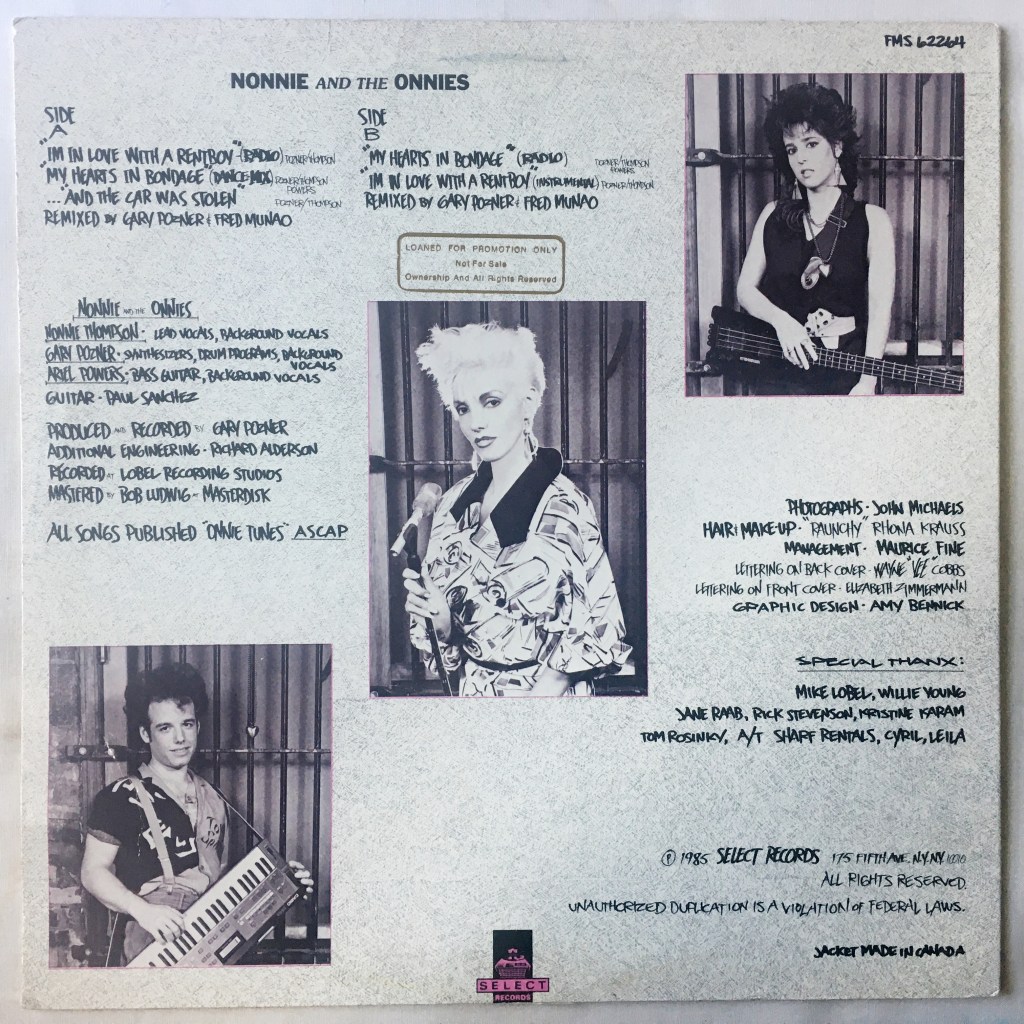
Nonnie and The Onnies is far from a household name. The group’s singular 12″ release isn’t much more than a relic of an industry in an era, but perhaps we can find new respect for such an album.

I’m in Love With A Rent Boy‘s sound is what’s to be expected from an American pop group only 2 years after the release of Madonna’s self-titled debut, albeit lacking Madonna’s synthetic-disco sound for something straddling the Bangles.

The mix is delightfully punchy, the album’s cover art amusing, and its absurdity somewhat intriguing. Rent Boy may be brief, but that only makes it more consumable.

Titular a-side opening track Rent Boy comes with all the trappings of new wave overindulgence and electronic trend following, much to the anguish of any current listener. The absurdity of I’m in Love With A Rent Boy may be the only thing not somewhat forgettable about this track, unfortunately.

Under all of Rent Boy’s commercial cheese is an extravaganza of American generica. Flavorless, plugged in, and devoid of self-reflective or interpersonal emotion. An overproduced musical jingle reminiscent of over-the-top TV ads.

A swing and a miss perhaps, as following track My Hearts in Bondage (Dance Mix) is so satisfyingly engaging. Hearts inches towards EBM with pounding drum machine rhythms driving under dark synth pads. Choppy self-sampling punches up the song’s pop vocal delivery. Its lyrics may not be particularly inspired, but Nonnie’s performance sells me on the emotions at play.

A shame, really, that a track so good would be hidden behind a pop single so bad. Hearts in Bondage may have been overlooked by a loving audience due to the EP’s titular track, but perhaps our current state of retromania will help unearth previously overlooked gems.

Rent Boy‘s A-side closes out with the instrumental …And The Car Was Stolen. It explores a further industrial element over it’s 42 second runtime before disappearing into the void. Far from a substantial song, Car Was Stolen functions as the perfect cinematic mood-setter for a would-be album of Hearts in Bondage.

The album’s b-side should at least be mentioned as a formality; a radio edit of Hearts in Bondage with an instrumental remix of Rent Boy to close out the EP. Unforgivably 80s in an unlovable way.

There is good work to be found on Rent Boy, if only the right crowd were to find it.

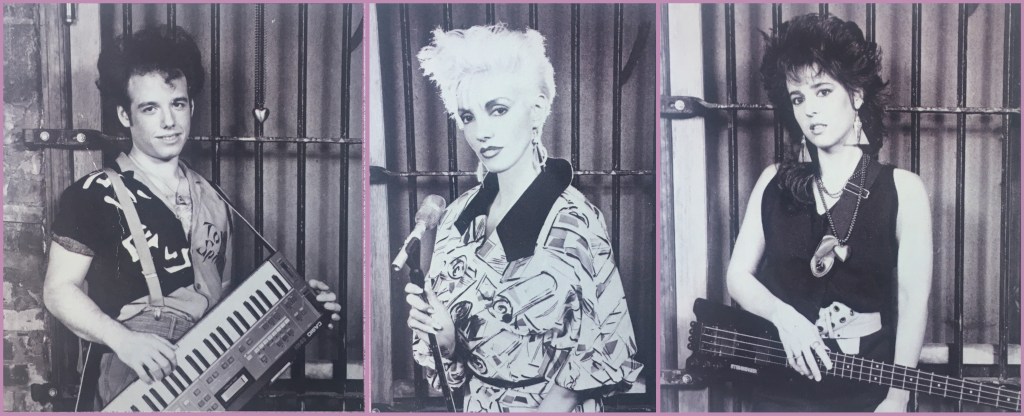
L to R: Gary Pozner, Nonnie Thompson, Ariel Powers.

If you’re curious what Nonnie Thompson has been up to since, this article from 2006 will have to suffice. Ariel Powers wracked up some more credits to her name throughout the 90s, and is still playing to this day. Gary Pozner, last I heard, is playing music around the south-west US.

For fans of: Madonna, Bananarama, Ministry (With Sympathy-era)

Like Nonnie and The Onnies? Give these a listen: Nocera, Front 242, Glass Candy
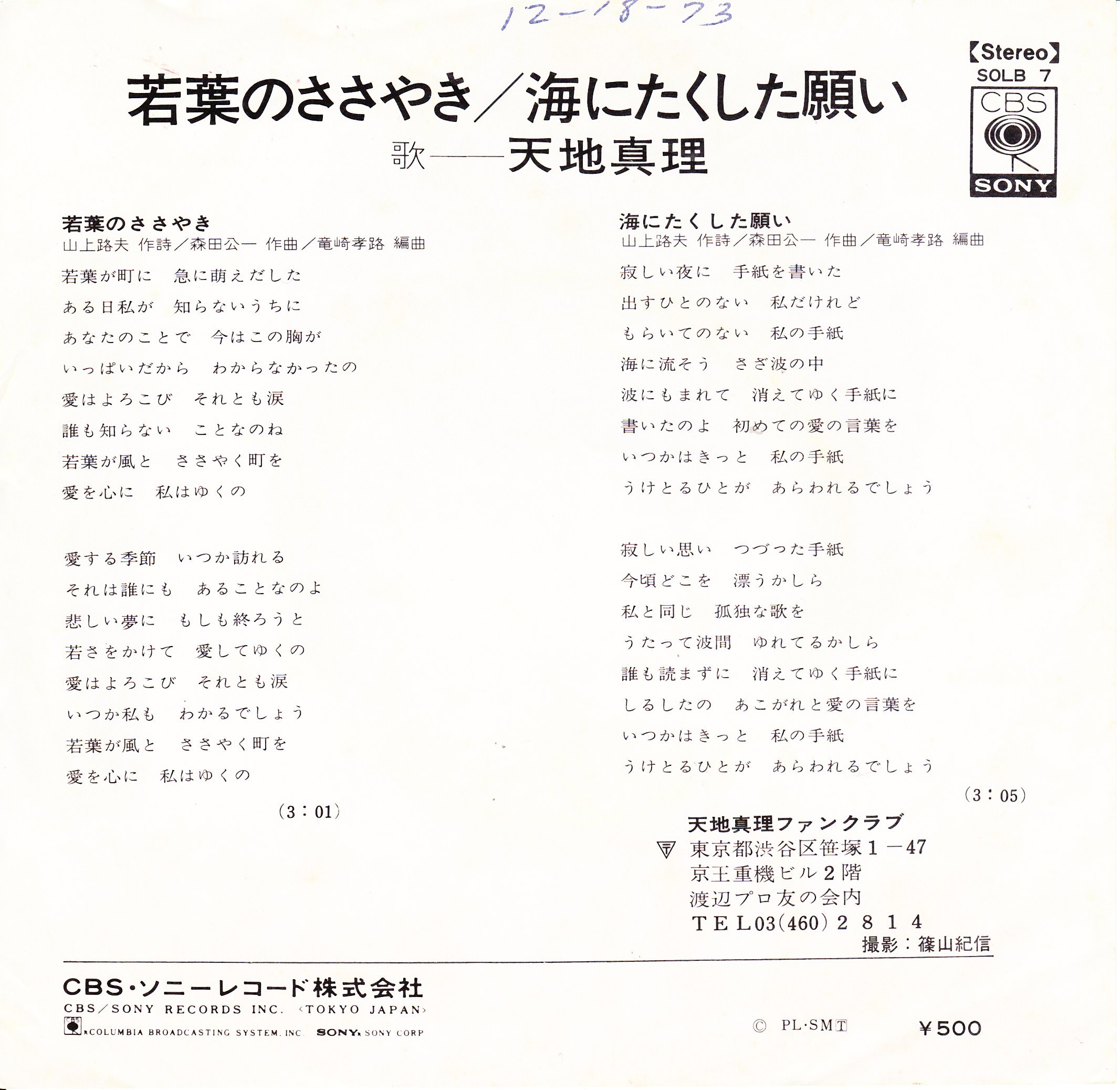
REVIEW: Mari Amachi – Whispering Green Leaves b/w Wishing Upon The Sea 7” (1973)

There is nothing too ground breaking or distinct about this 7”. Mari Amachi was considered “Sony’s Snow White” in Japan, as well as the start of Japanese idol culture in the 1970s/80s. Maybe from an outsider (both in time and place) this translates to a lack of appreciation for what would make this record in particular stand out.

Taking up the record’s a-side, a cinematic quality pervades Whispering Green Leaves. Instrumentation plods along, complimented by exciting flurries of strings. Whispering Green Leaves’s cinematic qualities are best exemplified by lush Mancini-esque string arrangements which thrust the composition into amplified emotions.

Nearly a decade prior to electro pop, this record manages to escape the fetishism of retromania’s preferred sonic tropes. Maybe this allows the listener to hear the record as objectively as possible. Even then, it’s impossible to eradicate personal tastes (however manipulated they may be).

B-side track Wishing Upon The Sea (海にたくした願い) is made-for-TV (70s TV, that is). I mean that as a good thing, somehow. Relying on my outsider’s ignorance, Wishing Upon The Sea’s 1970s trappings weren’t the antagonizing cheese of my childhood.

Backed by Sony’s impressive session musicians of the time, Mari Amachi’s singing is particularly beautiful here. Each piece of instrumentation compliments each other in hopeful melancholy. It’s not quite a powerhouse of emotional display, but still delivers a mildly entertaining listen.

Perhaps it is as it appears to be, a mildly enjoyable but somewhat forgettable pop record of yesteryear. Whispering Green Leaves may not be heavily sought after in this day and age, but if you can get your hands on it, Wishing Upon The Sea is a delightfully pleasant b-side worth the occasional spin at home.

For fans of: Doris, Alice Dona, Stelvio Cipriani

Like Mari Amachi? Give these a listen: Giuliano Sorgini, Clothilde, Armando Trovajoli

REVIEW: Knitted Abyss – Bad Lassies (2019)

Bad Lassies is the 2019 debut album by Australian experimental pop duo Knitted Abyss. Members Lucy Phelan and Anna John bring an ambitious level of creativity to darkwave and post-punk that their ‘nu goth’ contemporaries (I won’t call them peers) fail to deliver. Bad Lassies‘s quirky eccentricities distance the band from their contemporaries’ dismal artistic stagnation, yet these quirks never feel gimmicky. No, Bad Lassies’s emotional delivery is only ever enhanced by the artistic choices made.

Album opener Attention is a minimal post-punk track reveling in its loneliness. Squelchy synth bass and light drum machine work give the band an almost early-80s Bananarama rhythm section, blanketed in the more morose qualities of gothic post-punk classics. From here things get darker, less pop oriented, but never losing a distinct sound established from the start.

Inspiration and stylistic elements are lifted and fitted together well without ever falling victim to pastiche. Elements of darkwave, post-punk, shoegaze and Ladytron-esque electronic pop are prevalent and well mixed together to create something new. Knitted Abyss dismisses the queue of bands lining up for ‘cool factor’ authenticity by creating something distinctly their own. Lucy Phelan and Anna John created a well-crafted album, and therefor don’t need to mold to any perceived idea of ‘how things should be’ within a genre.

For fans of: Crack Cloud, Waitresses, Crash Course in Science

Enjoy Knitted Abyss? Give these a listen: Casket Girls, Cold Choir, Tropic of Cancer

A Proposal for 80s Worship

This post originally appeared on the 10th Dentist blog on Tuesday, March 4th, 2021. The following version has been lightly edited for clarity.

    As if standing in stark contrast to taco-laser-cat t-shirts and ‘millennial whoop’ overdosing (how noble), the rise of 80s worship in the mid-teens has brought back the worst of bad hair days and their musical counterparts. So if you’re looking to spice up your new-found identity or if you’ve finally realized that Africa by Toto isn’t worth it, than this list is for you!

Soft Cell – The Art of Falling Apart (1983)

    Soft Cell (a band that, yes, has released more than 2 songs) started in 1978 and rose to prominence in the early 80s with their hit cover of Gloria Jone’s 1964 single ‘Tainted Love’. But enough of that. 1983 would see the release of Soft Cell’s second full-length release The Art of Falling Apart and the glory of it’s titular closing track. ‘The Art’ is a song about drugs that isn’t trying to be anything other than a song about drugs. Big synth stabs and an under swelling reverb makes this a ‘no duh’ for anyone looking to dip their toes in the weird and wacky world of the 80s (FOETUS is only a few steps away from here).

Naked Eyes – Promises, Promises (1983)

    There is always something there to remind me that there were much better songs on Naked Eyes’s 1983 album Burning Bridges. The best album to ever be recorded at Abbey Road Studios (Flippant? Maybe. The truth? Definitely), Burning Bridges gave us great songs like its titular track, When The Lights Go Out, Fortune and Fame, and Voices in My Head. But it’s Promises Promises with its minimal production, back and forth melody, and vague funk influences that rounds out this album as one of the best closing tracks on a pop album ever. Naked Eyes is 2 British guys, a Fairlight CMI, and a lot of vague romantic dance tracks. Do I need say more? Well, except to clarify I mean that entirely as a good thing (in this case).

Orchestral Manoeuvres In The Dark – So In Love (1985)

     So In Love may not be stupid enough to meme-ify, but it’s an emotionally powerful song with all the melancholic nostalgia seeding you could possibly want. In this dreamlike state, you may feel as if your feet will lose rhythm to it’s smooth dance beat as you float away off the dance floor. Don’t worry, no modern DJ will be playing this any time soon, and your drinking that night will likely leave you face first on the floor. Look, were they a great band? No, not really. But if we’re going to collectively obsess over singular 80s pop tracks, OMD has all the trappings (and just enough good songs) to get a mention here.

Sharon Redd – Can You Handle It (1980)

    While you were busy fetishizing the 80s, disregarding the AIDS epidemic and the CIA starting a racialized drug war, black and/or queer people were out there making some of the best music of the decade. If you’re looking for peak 80s (in a good way), this is it. Just because it’s not Madonna-white doesn’t make it not so. So, can you handle it?

    You may think, ‘why Sharon Redd? Why not something even more 80s like Chaka Khan, Cherrelle, Evelyn King, etc.?’ Those artists are amazing, but they’ve all had second-winds in the age of music streaming and cock and bull ‘I grew up with this’ nostalgia boasts. Either way, if you’re a trend sycophant than you’ve probably stopped reading a while ago. So kick back and enjoy this 6min+ jammer.

General Public – Anxious (1984)

    Why are we culturally pining for the 1980s to begin with? Has sociopolitical pressures made us look for a ‘simpler time’?  Is it 70s babies grasping for a time that they were the forefront of commercial culture? Can we simply blame all of it on vaporwave and Stranger Things? Who knows. Maybe culture is dying. In a press-play world that awards content and volume over quality and craft, why would anyone take the time to enrich their lives culturally? It may be my upbringing that put General Public on this list, but if the 80s are relevant now, than a track like Anxious is more relevant than ever.